
Why Japanese Capital May Finally Be Coming Home – by Westminster Asset Management
“Why Japanese Capital May Finally Be Coming Home”: Westminster Asset Management Investment Strategist Peter Lucas looks at developments in Japan, for the first time in a while. Peter argues that a number of long running interrelated factors that have driven the yen and Japanese government bonds ever lower might finally be coming to an end.
Markets continue to view Japan through the lens of the past: negligible bond yields, relentless capital exports and chronic yen weakness. That framework explained the previous decade remarkably well. My contention is that it may no longer explain the next one. For decades, Japan has been a major exporter of capital. Faced with negligible domestic bond yields and repeated monetary easing by the Bank of Japan, pension funds, insurers, corporations and households sought better returns overseas. The result was one of the world’s largest net foreign asset positions, while from 2020 the yen became the funding currency of choice.
Charles Gave (Gavekal Research) argues that policy changes introduced in March 2023 urged Japanese companies to deploy cash more aggressively overseas rather than allowing it to sit inert on domestic balance sheets. Coincidentally or otherwise, the yen embarked on another major leg lower while Japanese government bonds entered a sustained bear market.
I cannot prove that these developments were causally linked, but my inference is that a new wave of outward capital flows placed simultaneous downward pressure on both Japanese government bonds (JGBs) and the yen. If that interpretation is broadly correct, the more important question today is whether those flows are about to peak.
The investment case for Japanese government bonds has improved significantly. For much of the past decade, Japanese government bonds had little to recommend them. Yields were close to zero – often below inflation – while the Bank of Japan effectively dictated prices through yield curve control. Domestic investors had every incentive to seek higher returns overseas.
That investment case has changed materially. Nominal yields are now meaningfully higher and Japanese investors can once again earn a respectable domestic return without assuming foreign exchange risk or paying the cost of hedging overseas investments.
In my own research, the valuation measure that has shown the strongest relationship with subsequent sovereign bond returns is the difference between the current ten-year government bond yield and average nominal GDP growth over the previous eight years. On this measure, JGB valuations are cheap relative to their own history and relative to US, German and UK government bonds.
The investment case for the yen is, if anything, even stronger. In real, inflation-adjusted terms, the currency is close to its weakest level of the floating exchange-rate era. It has also diverged markedly from its long-standing relationship with both interest-rate differentials and the Chinese renminbi. Investor positioning remains skewed against the currency.
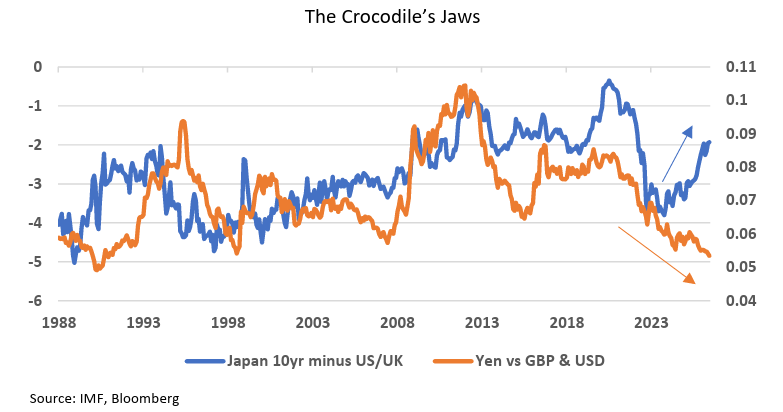
The divergence between the yen and interest-rate differentials is particularly striking. Normally, improving yield support would be expected to strengthen the currency. Instead, yield differentials and the yen have moved further apart, like the jaws of a crocodile opening ever further. My interpretation is that outward capital flows have overwhelmed the conventional interest-rate relationship. If those flows are now approaching a peak, the jaws may finally snap shut, with the adjustment occurring primarily through a stronger yen.
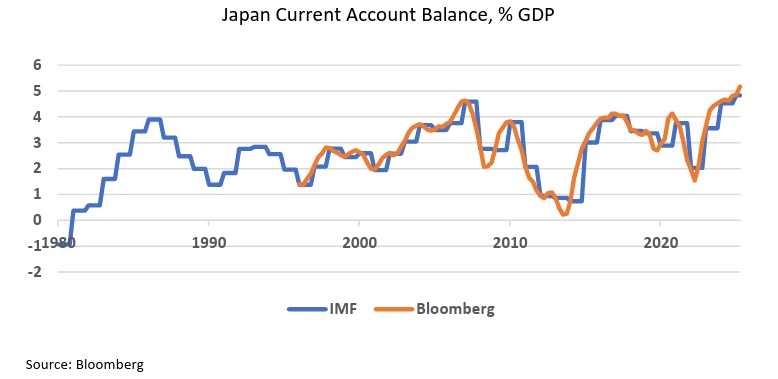
Yet perhaps the biggest anomaly lies elsewhere. Strong currencies are often backed by large current account surpluses. Japan’s external surplus is now the largest it has been for decades. Ordinarily, such a surplus would be expected to generate sustained demand for the domestic currency.
The explanation lies in the composition of that surplus. Increasingly, Japan’s current account is driven not by merchandise exports but by income earned on its enormous stock of overseas assets. Dividends, interest receipts and corporate profits appear to have been retained or reinvested abroad rather than converted back into yen. In other words, Japan is generating enormous foreign income without creating equivalent demand for its own currency.
If overseas investment accelerated after 2023, there are good reasons to believe that the forces driving that acceleration are beginning to reverse. Japanese bond yields are higher, the cost of hedging foreign investments has increased, and domestic assets no longer look as uncompetitive as they once did.
Official policy may also be doing an about-turn. Having spent years encouraging Japanese investors to seek higher returns overseas, policymakers are now openly calling for more investment in domestic assets. While governments cannot compel private capital to return, they can influence its direction at the margin.
A modest reduction in overseas reinvestment, greater foreign exchange hedging, higher domestic bond allocations or increased repatriation of overseas earnings could all generate substantial demand for yen while simultaneously supporting JGBs. Once underway, the process could become self-reinforcing. Higher domestic bond prices would encourage further investment at home. Reduced capital outflows would support the yen. A stronger yen would lower imported inflation, improving the real return on domestic fixed-income assets and further strengthening the case for holding JGBs.
None of this requires a dramatic reversal of Japan’s role as a major international creditor. That position is unlikely to change. But if the latest wave of capital exports has peaked, the marginal flow of Japanese savings may increasingly favour domestic assets – creating the conditions for prolonged outperformance by both JGBs and the yen.
Peter Lucas – July 2026